Bathla Group collapse: three years of public warnings
Universal Property Group entered voluntary administration on 25 August 2026 owing more than $3.5 billion. The group said it had almost 26,000 homes in development across Sydney's west. Four months earlier its accounts were signed with a clean audit opinion. Every warning sign in between sat on a public register.


What the public record showed
None of the following required a data room, an insider, or a subscription to anything exotic. Each item sat on a government register, in a court judgment, or in a lodged document — dated, and available to anyone who went looking.
- Apr 20233 years out A $39.5 million purchase fails to settle. A group subsidiary contracts to buy land at Box Hill in Sydney's north-west. Completion is due 18 April 2023; the notice to complete expires unpaid on 3 May after two extensions.
- 31 Oct 20232.8 years out The Supreme Court orders specific performance against the company and against its director personally, jointly and severally, finding the guarantee created liability as principal rather than mere indemnity (Ryan v UPG 322 Pty Ltd [2023] NSWSC 1293). It is reported as still unpaid, now exceeding $70 million with interest.
- Q3 20242.3 years out Land buying stops. The group had registered 201 single-purpose site companies in 2021 alone. The last one is registered in the second quarter of 2024. None follows in 2025 or 2026.
- Late 2025~9 months out The anchor lender leaves. A decade-long primary financier winds a reported $670 million exposure to zero. The group refinances into a syndicate of private credit funds at higher cost.
- 1 Nov 2025297 days out The accounts go overdue. A large proprietary company must lodge within four months of year end. The regulator's own record sets the due date at 31 October 2025, unextended. Nothing is lodged.
- 24 Apr 2026123 days out The accounts arrive 175 days late — and show the problem. A reported profit of $61.9 million sits alongside operating cash flow of negative $150.0 million, funded entirely by $160.3 million of new borrowings. Cash of $14.5 million stands against $2.85 billion of debt, every dollar of it classified as falling due within twelve months. The audit opinion is unmodified, with no going-concern emphasis.
- 16–30 Jul 202626 days out The regulator acts on the building licence. On 16 July a $1,500 penalty notice issues against Raj & Jai Construction for a contractor licensee contracting to an unlicensed party (s.4(2) Home Building Act). On 30 July, two disciplinary actions follow for improper conduct: a $45,000 fine under s.62(1)(c), and conditions imposed on the contractor licence itself under s.62(1)(d), with immediate effect. Twenty-six days later, administrators are appointed. Across both building licences the group's enforcement record totals $47,000 — and $46,500 of it lands in this single fortnight.
- 16 & 30 Jul 202640 and 26 days out The regulator acts. A penalty notice against the group builder's licence for contracting work to an unlicensed corporation, then a $45,000 fine — against a statutory maximum of $50,000 — and conditions imposed on the licence with immediate effect.
- 25 Aug 2026the day Administrators appointed to the parent and to two related construction companies.
The number nobody checked
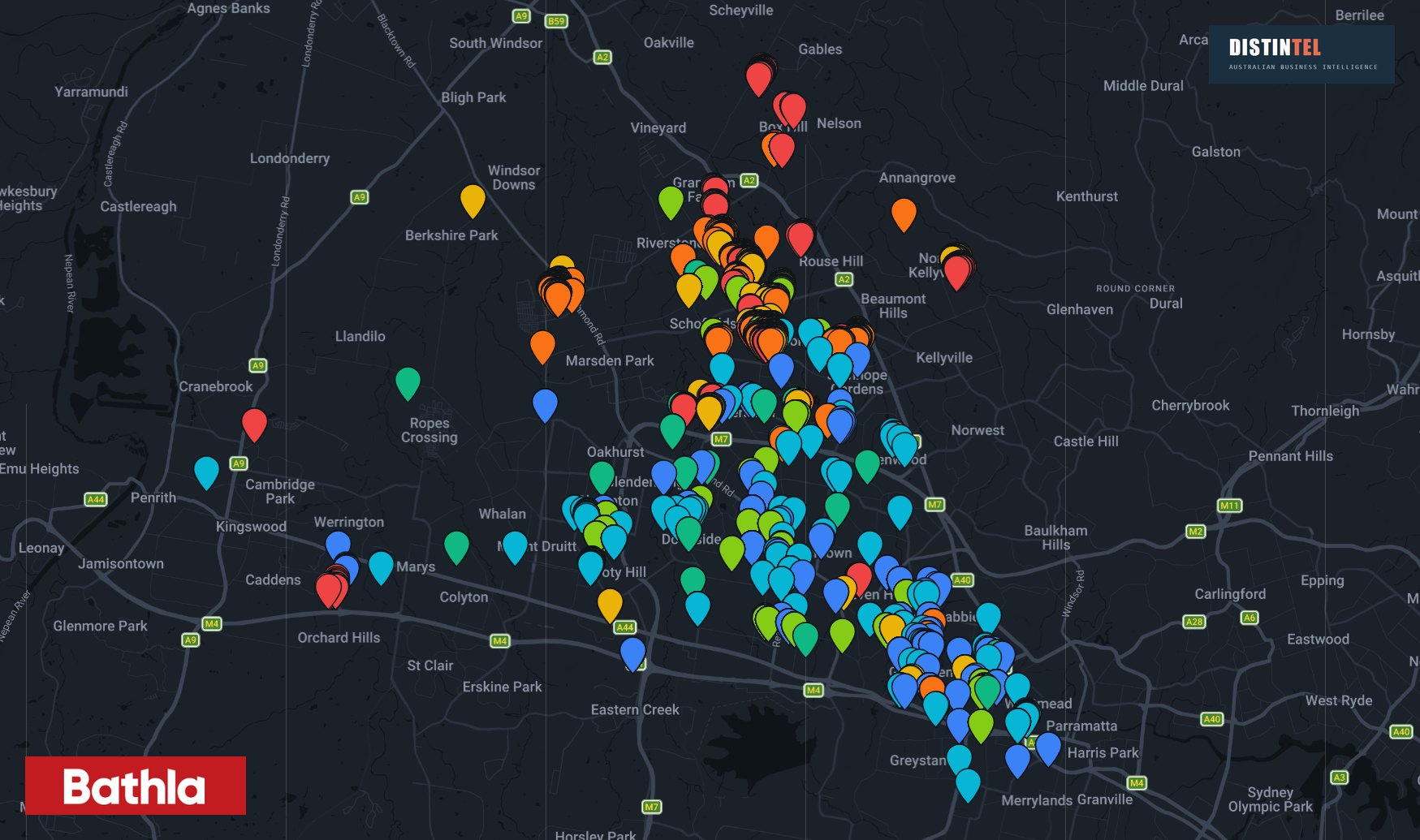
Every report of this collapse has carried the same figure: almost 26,000 homes under development. It is worth knowing where it comes from. It is the group’s own claim — 22,000 apartments and 3,500 houses in its “project pipeline” — repeated onward without being tested against anything.
So we tested it against the only two sources that can speak to it: the group’s own current listings, and the insurance register.
There is a second test, and it does not depend on matching anything to an address. A home warranty certificate is taken out per dwelling before residential building work begins, so the count issued in a year is a count of construction starts. Those numbers are simply counted, not matched, and they are not in dispute.
In fifteen years of building, from 2010 to 2025, this group took out 7,516 certificates in total. Every dwelling it has ever insured, across its entire history, amounts to less than a third of the number it said was under development. In 2024 it started 265. In 2025 it started 261. At that rate, 26,000 homes takes a century. At the group’s best year on record — 1,504 starts in 2021 — it takes seventeen.
The obvious objection is that 7,516 must be an undercount — that other companies in a group this size held certificates of their own. They did not, and the licence register says why. In New South Wales a company cannot contract to carry out residential building work unless it holds a contractor licence. Of more than six hundred companies bearing this group’s naming, two hold one: Universal Property Group and Raj & Jai Construction. The same two that hold all 7,516 certificates.
That is not a criticism of the structure. A single-purpose company can own land, obtain consent and engage a licensed builder; that is ordinary and lawful, and it is what the certificate at 28 Madden Street shows happening. But it does mean the number is not a sample. Every dwelling this group was licensed to build had to pass through those two entities — and one of them stopped issuing certificates in February 2023.
The register cannot see apartments above three storeys, and 22,000 of the 26,000 claimed are apartments, so that comparison is incomplete by design. But the group’s own marketing can see them, and it advertises seven apartment projects between Marsden Park, Pemulwuy, Castle Hill, Schofields and Box Hill, disclosing 672 dwellings between them.
Which leaves the phrase itself. A home under development, to anyone buying one, means a building with people working on it. It does not mean a paddock with a consent attached, and it does not mean land held for a stage that has not started. Those are real assets and there is nothing improper about holding them — but they are land, and reporting them as homes under development tells a purchaser, a lender and an administrator something quite different from what the ground shows.
Two caveats matter, and both cut in the group’s favour. A listings site shows what is currently for sale, not what has already sold or is yet to launch. And eight of the 27 projects state no dwelling count, so 1,856 is a floor rather than a total.
A third point cuts the other way. Off-the-plan stock is marketed during construction, before an occupation certificate exists — which is exactly why an advertised project is reasonable evidence of a development genuinely under way. These 27 are the group’s own account of what it is building, published by the group, on the day it entered administration.
None of that closes a gap of this size, and none of it is really the point. The point is the phrase doing the work. “Under development” covers land banked, land approved, land under construction, and homes actually for sale — four states with entirely different meanings for a buyer, a lender and an administrator. The figure was reported as though it described the last of those.
How much of it had actually started
A home warranty certificate must be taken out for each dwelling before residential building work begins, which makes its date a construction start. Where certificates can be matched to a project, they say when the work began. Where they cannot be found, they say very little — and it is worth being clear about why.
An earlier version of this article counted advertised dwellings with no matching certificate and reported that most had not started. That measure does not hold, and the reason is worth keeping in view. Hillview Terrace at North Kellyville is advertised at 3–23 Hillview Road and its construction is complete. The townhouses are three storeys, which matters: the exemption reaches a rise of more than three, so cover was required for every one of them. The register holds no certificate on Hillview Road — and 111 across nine adjoining streets in the same suburb, against a project of 110 townhouses. Street-level imagery from 2025 shows the terraces part-built and scaffolded behind the group’s own site fencing. The work happened, it needed cover, and the cover exists; it is simply recorded against the internal roads the development built rather than the address it is marketed under. The absence of a certificate at a marketed address is therefore not evidence that nothing was built.
Two further reasons the reverse test fails. On a land subdivision the purchaser engages their own builder, so the certificate names that builder and the developer never appears — at 28 Madden Street, Oran Park, the certificate names Samaro Homes Pty Ltd of Camden. And SIRA, which maintains the register, warns that insurance is sometimes purchased before subdivision or strata registration, so dwellings “are not assigned correct unit/lot numbers or a street address”, a risk it says is higher for new developments.
One address shows how completely. At 28 Madden Street, Oran Park, a certificate does exist — HBCF22034272, issued 20 June 2022 for a new single dwelling. The principal contractor named on it is Samaro Homes Pty Ltd of Camden, licence 241811C. Not the group. The lot was sold, the purchaser engaged their own builder, and that builder took out the cover. On a land subdivision the developer may never appear in the insurance register at all, which is precisely why those projects cannot be tested this way.
A zero is the kind of result that is usually a matching error, so each was checked against every street the register holds in that suburb. North Kellyville returns nine streets — Croke, Fenway, San Siro, Elland, Headingley and others — and no Hillview Road. Marsden Park returns thirteen, and no Grange Avenue. The zeros are real.
The land subdivisions are worth a look even so. Street-level imagery of 156 Old Pitt Town Road at Box Hill, captured in September 2025, shows the site hoarded in the group’s own branding with the original dwelling, gate and driveway still standing behind it, and no construction under way. Eleven months later, 67 lots on that address were still advertised. Land can of course be sold without being built on — but a masterplanned community that has not broken ground is a pipeline, not a project.
Two projects sit at the opposite extreme, and they are just as telling. Kensington Park Road at Riverstone carries 123 certificates against 116 dwellings advertised — every one issued on 31 July 2019. Oramzi Road at Girraween carries nine against nine, all issued on 29 July 2021. Both are still being advertised for sale. That stock was started six and five years ago respectively.
Between those two extremes sits the shape of the problem. A group describing tens of thousands of homes under development was, on its own advertised projects, mostly holding land it had not begun to build — and where it had built, some of that stock had been sitting unsold since 2019.
One address is worth following all the way down, because the council’s own file explains what the register only hints at. At 226–228 Grange Avenue, Marsden Park, the group advertises 86 Torrens Title three, four and five-bedroom homes. No certificate exists for that street. Aerial imagery from 2026 shows the site cleared, with spoil heaps and scraped earth and no buildings on it.
The consent documents are dated 15 December 2018 and issued for development application in April 2019. One set is titled “proposed flat building development — child care and residential”, runs to Level 5 over two basements, and is marked on its own title block as Lot 26 of proposed DA 19-00123. A second, from the same consultant and client, is a stormwater plan for a “proposed subdivision” at the same address. One site, two components: a flat building that clause 56 exempts, and a subdivision of houses that it does not.
Then the reason nothing was built. On 21 February 2025 a modification application was lodged against the consent, seeking to vary condition 3.4 — in the council’s words, to allow a “building Construction Certificate prior to registration of mother subdivision under DA-19-00819”. The condition requires the parent subdivision to be registered before any building certificate can issue. Six years after the design drawings, it had not been. The council refused the modification on 12 September 2025.
That is not a developer choosing to wait. It is a site that could not lawfully proceed to construction, on a consent first issued in 2019, with homes advertised for sale throughout. A separate listing portal still carries the address as 23 residences, “in planning”, awaiting approval, for completion in mid-2029.
One further date, offered without a claim attached to it. The last home warranty certificate taken out anywhere by either building entity in this group was issued on 16 September 2025 — four days after that refusal.
The caveats, and they are real. Matching is by street and suburb, so a project selling a later stage under a different street name would under-count. Apartments are excluded entirely, because above three storeys no certificate is required and their absence would prove nothing. And SIRA, which maintains the register, warns that insurance is sometimes purchased before subdivision or strata registration, so that dwellings “are not assigned correct unit/lot numbers or a street address” — a risk it says is higher for new developments, which is exactly what these are. A zero on this measure is evidence that work has not started. It is not proof.
It borrowed $160m to pay $243m of interest
The FY25 cash flow statement reconciles exactly and needs no interpretation. Trading generated $92.6 million before interest. Interest cost $242.6 million. The hole was filled with new debt — the only financing line in the statement. There were no repayments and no equity, and the same pattern had run the year before.
Why it still looked survivable
Revenue recognises on settlement, which trails a construction start by one to two years. So FY25 revenue of $1.18 billion was settling work commenced in 2022 and 2023. The income statement was reporting decisions taken years earlier, while the forward indicators had already turned.
A $3.7 billion group reported like a small business
The group prepared its accounts under Simplified Disclosures — the reduced Tier 2 regime. That was entirely proper. The test for full Tier 1 reporting is not size; it is public accountability: broadly, whether an entity has debt or equity traded in a public market, or holds assets in a fiduciary capacity for outsiders. A large proprietary company whose lenders are private credit funds has neither.
Size determines only whether you report at all. This group cleared every threshold many times over — $1.19 billion of revenue against a $50 million test, $3.69 billion of gross assets against $25 million, 226 employees against 100. None of that moved it up a tier.
| Waived under Tier 2 | What it would have shown here |
|---|---|
| Maturity analysis of financial liabilities | When, within twelve months, $1.94bn actually fell due — and to whom |
| Liquidity and credit risk, sensitivity analysis | Headroom for a group with $14.5m of cash and a $242.6m annual interest bill |
| Segment reporting | The split between houses, land and apartments — which determines what consumer protection applies |
| Fair value hierarchy | How $3.51bn of inventory carried at "lower of cost and net realisable value" was actually assessed |
Of everything Tier 2 waives, the single disclosure that would have made this collapse legible to an outside reader — the maturity analysis of $2.85 billion of borrowings — is the one not required. The accounts disclosed that $1.94 billion was current. They disclosed nothing about the shape of that cliff.
Over the past decade, development finance in Australia has migrated substantially from banks to private credit. The disclosure regime did not follow, because it was never indexed to systemic importance — only to whether your creditors happen to be public.
Which entity was actually insured to build
Home warranty certificates are the closest thing this country has to a construction start register. One is taken out per dwelling before residential building work begins, and it names the builder. Across this group there are 7,516 of them, held by exactly two licensed entities.
This matters directly to anyone holding a contract. The entity that took out the certificate is the entity that owes the statutory warranty — and it need not be the entity on the sign, in the brochure, or in the news coverage. It is written on the certificate itself.
One number frames everything that follows. Of those 7,516 certificates, eleven are for apartment building construction. Not eleven per cent — eleven. The 22,000 apartments are almost entirely absent from the home warranty system, and the next section explains why that is lawful, expected, and very bad news if you hold a contract for one.
If you bought from this group
The most important thing to establish is which kind of contract you signed, because the protections differ.
- Whether your contract is off-the-plan, a split house-and-land package, or land only.
- The trust account statement for your deposit, and the name of the account holder. Your conveyancer has it.
- The deposit-release clause in your contract — and whether the deposit has in fact been released.
- The legal name of the vendor on your contract. It will be a numbered company, not a brand. Which company it is determines who you are a creditor of.
- Your sunset date, which governs when rescission rights arise.
A trust claim is proprietary and materially stronger than a creditor claim. If your money is held on trust it is not the developer's and cannot be pooled with the assets available to creditors. Find that out first.
Questions buyers are asking
What happens to my deposit if a developer goes into administration?
It depends on where the money is. Under section 66ZT of the Conveyancing Act 1919 (NSW), money paid under an off-the-plan contract must be held as trust or controlled money by a law practice or licensed conveyancer, and cannot be released to the vendor before completion. Money held that way is not the developer's — you have a proprietary claim that cannot be pooled with the assets available to creditors. If the deposit was released, paid directly, or never placed in trust, you become an unsecured creditor.
Is my off-the-plan apartment covered by home warranty insurance?
Probably not, if the building is more than three storeys. Home Building Compensation cover is mandatory for residential building work above $20,000, but clause 56 of the Home Building Regulation 2014 exempts new buildings with a rise in storeys of more than three containing two or more dwellings. For most apartment towers there is no policy, none was required, and none is missing. Those purchasers rely instead on the statutory duty of care under the Design and Building Practitioners Act 2020, the strata building bond, and their contract.
How much does the Home Building Compensation Fund actually pay?
The total limit is $340,000 per dwelling, set in the Home Building Regulation 2014 and unchanged in ten years. It covers non-completion, defects and ancillary costs such as alternative accommodation, removals and storage combined — not $340,000 for each. Within that total, non-completion is sub-limited to 20% of the contract price. Both SIRA and IPART have consulted on raising the cap because claims are reaching and exceeding it.
Which company did I actually buy from?
Large developers typically sell through single-purpose vehicles — one company per site. The name on your contract is likely a numbered company, not the brand you saw advertised. That distinction determines which entity you are a creditor of, and whether that entity is in administration. Check the legal name of the vendor on the front page of your contract of sale.
Could this collapse have been predicted from public information?
The signals were public and dated: a failed $39.5m settlement in April 2023 and a Supreme Court judgment that October; company formations ceasing in mid-2024; statutory accounts becoming overdue on 1 November 2025; a lender withdrawing a reported $670m through 2025; and regulatory penalties in July 2026. Each sat on a different register, which is why nobody assembled them in date order.
What this means beyond one developer
Nothing in this analysis is clever. It is a court judgment, a company register, a licensing register, an insurance register and a lodged financial report, read in date order. The signals were separated by years, sat in five different places, and belonged to five different agencies — which is precisely why nobody assembled them.
That is the actual failure, and it is a solvable one. A failed settlement is a court record. Late lodgement is a date. A lender exiting is reported. Negative operating cash flow funded by new borrowings is arithmetic. Each is weak alone. In sequence, against a balance sheet with $14.5 million of cash and $2.85 billion of debt, they are not.
This is what DISTintel.ai does
We link Australian public registers — ASIC, ABR, planning, licensing, insurance and court records — to the entities behind them, so patterns like this surface as they form rather than after the fact. If you are an insolvency practitioner, lender, or developer carrying counterparty exposure, that sequence is worth seeing early.
Prepared from public sources: the FY25 consolidated financial report of Universal Property Group Pty Limited lodged with ASIC on 24 April 2026 (Form 388), ASIC company extracts, Ryan v UPG 322 Pty Ltd [2023] NSWSC 1293, the NSW Fair Trading and Home Building Compensation registers, the Conveyancing Act 1919 (NSW), the Home Building Act 1989 (NSW) and Home Building Regulation 2014 (NSW), and contemporaneous reporting. Figures are as reported and have not been independently verified against underlying records. Company logos are reproduced for identification only and do not imply any association with or endorsement by DISTintel.ai. Nothing here is legal or financial advice, and nothing here asserts wrongdoing by any person or entity.